English
 日本語
日本語 Deutsch
 عربى
عربى 中文
中文

Solar Roof Brackets: How to Match Types, Materials, and Specs to Your Roof
 2026.09.03
 Industry News
A 500 kW array on a distribution-center roof rarely fails because of the modules. It fails where the frames meet the roof: a ballast tray that shifted in a storm, a tile cracked by an oversized hook, a membrane seam opened by a poorly sealed penetration. Solar roof brackets sit at exactly that junction, and they carry every kilogram of the array through every storm for 25 years or more.
The rule that should govern any purchase is this: the roof structure, its waterproofing system, and the wind and snow loads at the site determine which bracket you need. Price comes last. A bracket chosen in reverse order — unit cost first, structure later — is the most common origin of leak claims and storm damage in rooftop solar.
This article covers what a bracket system includes, how the main types map to specific roof surfaces, where aluminum and galvanized steel each win, and which specification numbers to demand before signing a purchase order. If you want the overview first, the roof PV mounting system category shows how complete product lines are organized.
What a Solar Roof Bracket System Includes
Suppliers use the term loosely; it usually means the full mounting assembly, built from three component groups:
- Roof attachments — tile replacement hooks, standing-seam clamps, L-feet fixed to rafters or purlins, or ballast trays that hold the array down with weight instead of fasteners.
- Mounting rails — aluminum profiles, commonly 40–45 mm series, spanning between attachments, with slot channels that let clamps slide and lock anywhere along the rail.
- Module clamps and hardware — mid and end clamps matched to frame height (typically 30–40 mm), plus bolts, T-nuts, and grounding washers.
The assembly has three jobs: carry dead load and live loads — wind uplift, snow, service workers — into the structure; leave the waterproofing layer intact; and hold row tilt and alignment without loosening over decades. A bracket that manages the first job but fails the second or third converts a hardware saving into a roofing invoice.
Matching the Bracket to the Roof Surface
Roof surface type is the first filter in selection. A mismatch caught at quotation stage costs a phone call; the same mismatch caught on site costs rework.
Flat roofs: non-penetrating versus penetrating
On flat and low-slope roofs, the decision is between weight and penetration. Non-penetrating (ballasted) systems, usually tilted 10–15 degrees, are held down by concrete blocks or pavers and require no holes in the membrane — the decisive advantage when a membrane warranty or rooftop equipment is involved. The trade-off is dead load: ballast adds substantial distributed weight, so a structural review of spare roof capacity is mandatory, not a formality. Penetrating systems anchor through the membrane into the structural deck; they are lighter and perform better in high-wind zones, but every penetration must be flashed and sealed, which moves quality control to the installation crew.
For a reference design of the ballasted approach, the card below shows a flat-roof system configured without touching the waterproofing layer.
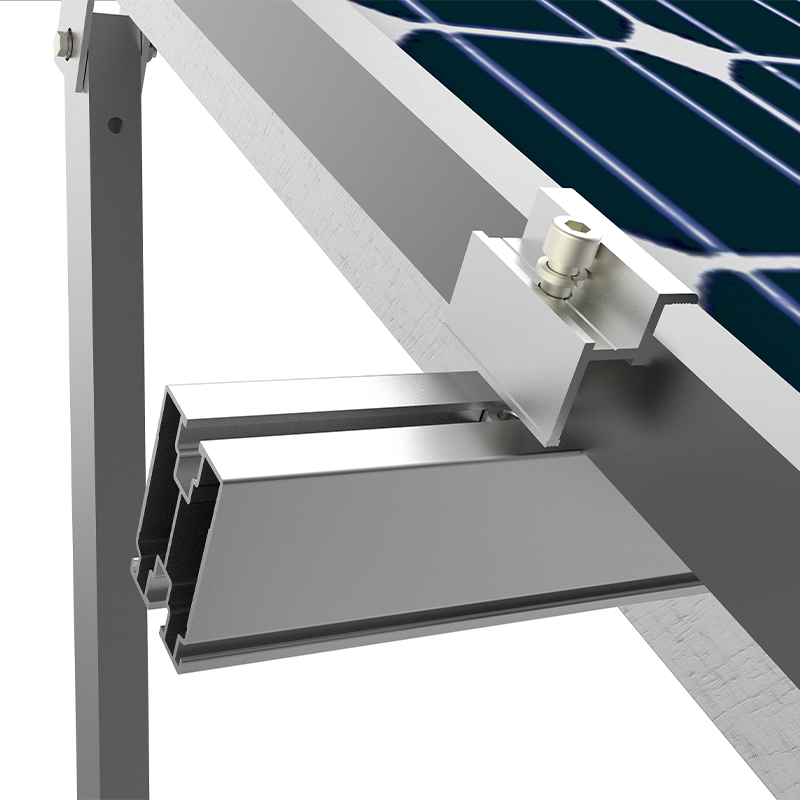 Non-penetrating PV MountingNon-penetrating PV Mounting is a mounting system designed for concrete flat roofs. Prefabricated concrete counterweights are used to avoid drilling holes to damage the...View Product →
Where wind loads are severe and the deck can accept attachments, an anchored design transfers uplift directly into the structure instead of relying on ballast weight.
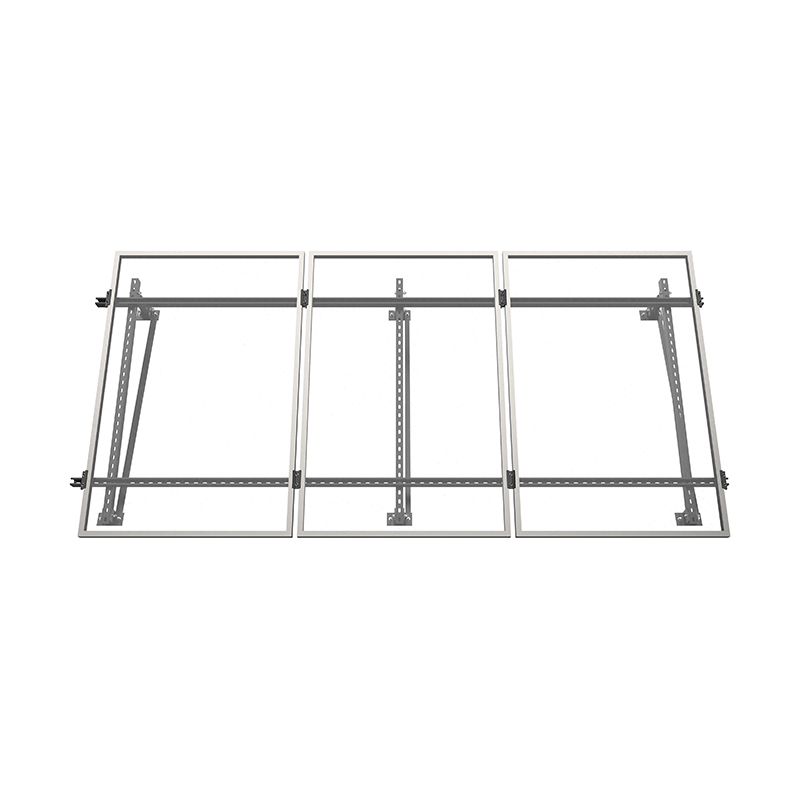 Penetrating PV MountingPenetrating PV mounting is a photovoltaic support system that directly penetrates the roof base (such as concrete, metal color steel tiles) through bolts, clamps and o...View Product →
Pitched roofs: metal, tile, and TPO coverings
On pitched roofs the attachment follows the covering. Standing-seam and trapezoidal metal roofs take clamp-style brackets that grip the seam without drilling, preserving both coating and warranty. Tile roofs use stainless replacement hooks fixed to the rafter, sitting under the cut or shimmed tile so the weather-lap stays intact. TPO and other single-ply membranes need load-distribution plates with welded or adhered reinforcement pads, so the membrane remains the waterproofing layer rather than being bypassed. On every covering, rail spacing must respect the rafter layout — a practical reason experienced suppliers ask for roof drawings before quoting.
For metal roofing specifically, the card below shows seam-clamp attachment and rail spanning designed around common standing-seam and trapezoidal profiles.
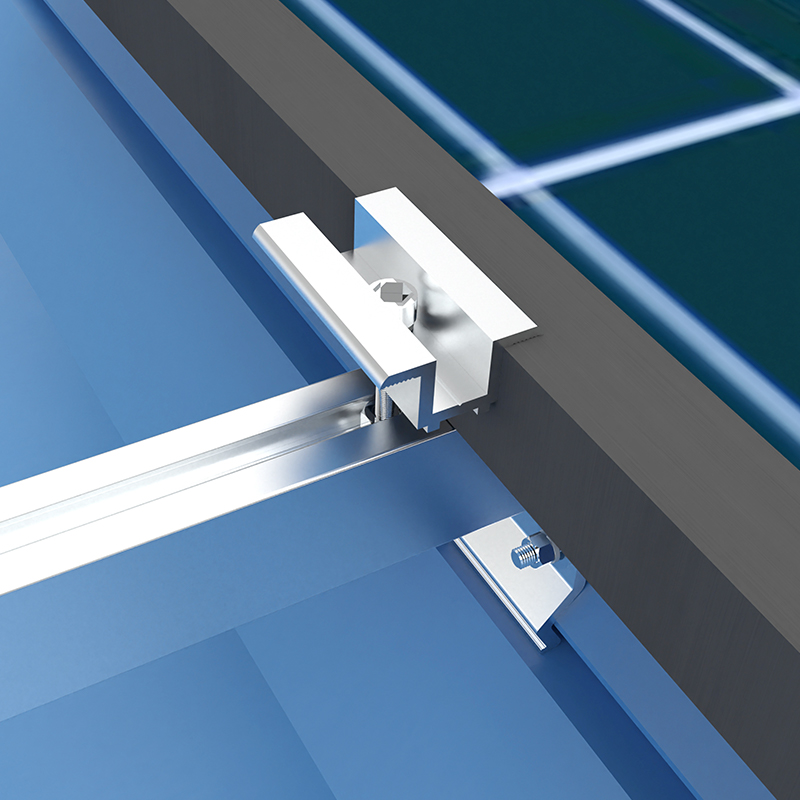 Metal Roof PV MountingMetal Roof PV Mounting is an installation system designed for metal roofs such as color steel tiles and galvanized sheets. It uses a clamp-type non-penetrating fixing ...View Product →
Aluminum Alloy vs Galvanized Steel: Where Each Material Wins
Conclusion first: anodized aluminum alloy is the default for rails and small brackets on most roofs, while hot-dip galvanized carbon steel earns its place where spans are long, ballast frames are heavy, or budget pressure dominates. The split follows from four measurable properties:
| Property | Anodized aluminum alloy | Hot-dip galvanized carbon steel |
|---|---|---|
| Density | About 2,700 kg/m³ — roughly one third the weight of steel | About 7,850 kg/m³ — heavy but stiff |
| Corrosion behavior | Natural oxide layer plus anodizing; handles coastal and humid air well | Zinc coating protects the base steel; coating thickness sets service life |
| Structural capacity | Lower stiffness; needs thicker profiles or closer attachment spacing | Higher strength and stiffness; suits long rails and ballast frames |
| Typical rooftop use | Rails, mid and end clamps, tile hooks, seam clamps | Ballast trays, penetrating flat-roof frames, BIPV substructure |
| Cost behavior | Tracks the aluminum market; lighter shipping offsets part of the premium | Lower per-kilogram cost, but heavier transport and handling |
The density gap drives most of that table. Visualized side by side:
Anodized aluminum alloy (6xxx series)
Hot-dip galvanized carbon steel
Because of that gap, a hybrid approach is common and sound: steel ballast frames or substructure carrying aluminum rails, with stainless fasteners and isolation washers wherever the two metals touch, so galvanic corrosion never starts.
Five Specifications to Verify Before Ordering
The fastest filter for a bracket supplier is to request numbers instead of adjectives. Five areas deserve written answers:
- Structural design inputs. Which wind speed, snow load, and terrain category the design was calculated for — a serious supplier issues project-specific calculations, not brochure values.
- Coating values. Anodizing film class for aluminum (commonly quoted as AA15 or AA20); zinc layer thickness for steel, for example around 65–85 μm hot-dip galvanizing for outdoor service, or roughly 275 g/m² pre-galvanized sheet where parts are formed after coating.
- Fastener grades. Stainless A2 (304) as the baseline, A4 (316) near coasts and pools.
- Waterproofing interfaces. EPDM pads under ballast feet, flashing plates for penetrations, and membrane-compatible contact materials — ask which membrane types the contact surfaces are validated for.
- Tolerances and torque. Slot width consistency for reliable T-nut engagement, rail straightness over the delivery length, and clamp torque values printed in the installation manual.
A supplier who answers these five with drawings and test references is a fundamentally safer purchase than one who answers with a lower unit price.
Procurement Risks That Surface on the Roof
Most bracket problems are bought upstream and discovered months later. The recurring ones:
- Buying per kilogram with no load documentation, which usually means the thinnest walls and the widest tolerances — discovered in the first serious wind event.
- Skipping the structural review of ballasted systems, then redesigning the layout after the owner's engineer rejects the dead load.
- Installing tile hooks sized for one tile profile under another, which cracks tiles or breaks the weather-lap.
- Mixing bare steel and aluminum parts without isolation, seeding galvanic corrosion that appears later as stains and seized bolts.
- Accepting deliveries without installation manuals, torque tables, or spare fasteners, stalling crews that bill by the day.
What a Full-Line Manufacturer Adds Beyond Hardware
Roof brackets are bought as components but chosen as part of a system decision. Suneast New Energy (Taizhou Dongsheng New Energy Technology Co., Ltd.) has worked on that basis since 2009, supplying distributed PV support structures from flat- and pitched-roof lines to BIPV waterproof systems, alongside ground, agricultural, fishery, and carport mounting. Its stated service chain — early site assessment, design, procurement, installation guidance, and later maintenance — addresses roof projects directly, because most of the risks listed above are settled at the design and guidance stages, not at the factory.
On capability, the company operates under an ISO quality management system and holds multiple racking patents; company-reported figures include more than 1.5 GW of distributed racking supplied in 2023 and participation in a 200 MWp fishery-solar project in Jiangsu. Whatever supplier you shortlist — including this one — ask for references on your specific roof type and the structural calculation package for your site.
Installation workmanship decides how much design margin survives contact with the roof, so a detailed walkthrough like this roof PV mounting design and installation guide is worth a crew briefing before work starts.
The Bottom Line for Buyers
Select the bracket category from the roof surface and structure first: ballasted non-penetrating for membranes with spare load capacity, anchored penetrating systems for high-wind zones, seam clamps for metal, replacement hooks for tile, welded pads for TPO. Fix the material by environment and span — anodized aluminum as the default, galvanized steel where loads demand it — and close the order with documented loads, coating thicknesses, fastener grades, and torque specs. Specified in that order, brackets cost a few percent more than the cheapest quote and remove the two most expensive failure modes in rooftop solar: water ingress and wind damage.
Message Us Now !

 +86-0523-80509588

 11th Floor, Wenchuang Building, 60 Fenghuang East Road, Hailing District, Taizhou City, JiangSu, China
Mounting Systems
Copyright © Taizhou Suneast New Energy Technology Co., Ltd.
All Rights Reserved.
 OEM/ODM Solar Panel Mounting Bracket Manufacturers