English
 日本語
日本語 Deutsch
 عربى
عربى 中文
中文

Solar Panel Mounting Brackets Guide: Types, Materials & Tips
 2026.08.06
 Industry News
What Is a Solar Panel Mounting Bracket and Why Does It Matter?
On a coastal warehouse roof, wind can lift a solar module with surprising force. On a snowy ground site, the same panel may have to support the weight of heavy, wet snow for days. The part that carries both loads is the solar panel mounting bracket, a small line item in the system budget, but the one that decides whether a PV plant stays safe and productive for decades.
The conclusion comes first: the bracket is the mechanical skeleton of the entire solar array. It holds each module at the correct tilt, transfers wind and snow loads into the roof or ground structure, leaves a ventilation gap under the panels for cooling, and, in many designs, protects the building envelope from water. Choosing the wrong one does not just mean a wobbly panel. It can lead to long-term corrosion, roof leaks, micro-cracks in modules, or even panels lifting off in a storm.
Three practical effects explain why the bracket deserves attention early in a project:
- Load handling: local wind and snow conditions should drive the structural calculation. An undersized bracket in a windy region will fatigue and loosen long before the modules wear out.
- Thermal performance: a proper gap between the module and the roof lets air flow and cool the panel, which helps maintain energy output on hot days.
- Waterproofing: every screw that penetrates a roof is a potential leak point. Bracket systems that avoid breaches, or seal them correctly, protect the building underneath for the full system life.
Key Factors to Consider When Choosing a Solar Bracket
When comparing solar brackets, use a simple four-dimension framework: installation scenario, bracket structure, material, and installation and maintenance convenience. Working through these four steps in order is faster and more reliable than starting with price.
Roof Type and Structural Compatibility
The most important question is not which bracket is strongest, but which bracket is compatible with the specific roof. Each roofing finish places different constraints on how a bracket may be attached, how much weight it can carry, and how the waterproofing layer should be protected.
On tile roofs, hook-style fixings that slide under the tiles are preferred because they avoid cutting or drilling through the tiles themselves. This keeps the original waterproofing layer intact and makes the structure easier to seal. For most residential pitched roofs, tile roof solar mounting solutions use this hidden-hook principle and are designed to match specific tile profiles.
On metal roofs, clamp-based brackets grip the standing seam without drilling. This matters because every hole in a metal roof exposes the anti-corrosion coating and becomes a possible leak path. Quality metal roof solar panel brackets are built around the seam dimensions and install without a single roof penetration.
On TPO and other single-ply membrane roofs, the standard approach is to use adhesive plates or heat-welded strips that bond directly to the membrane. These TPO roof PV mounting systems are lightweight, preserve the membrane warranty, and perform well on low-slope commercial buildings.
On flat roofs, the choice is between penetrating and non-penetrating structures. Penetrating systems are bolted into the concrete deck and are very stable, but they require careful flashing. Non-penetrating systems use ballast weights to hold the array in place. Because they eliminate roof openings, non-penetrating flat roof solar mounting systems significantly reduce leak risk and are often the first choice for buildings with new or repaired membrane roofs.
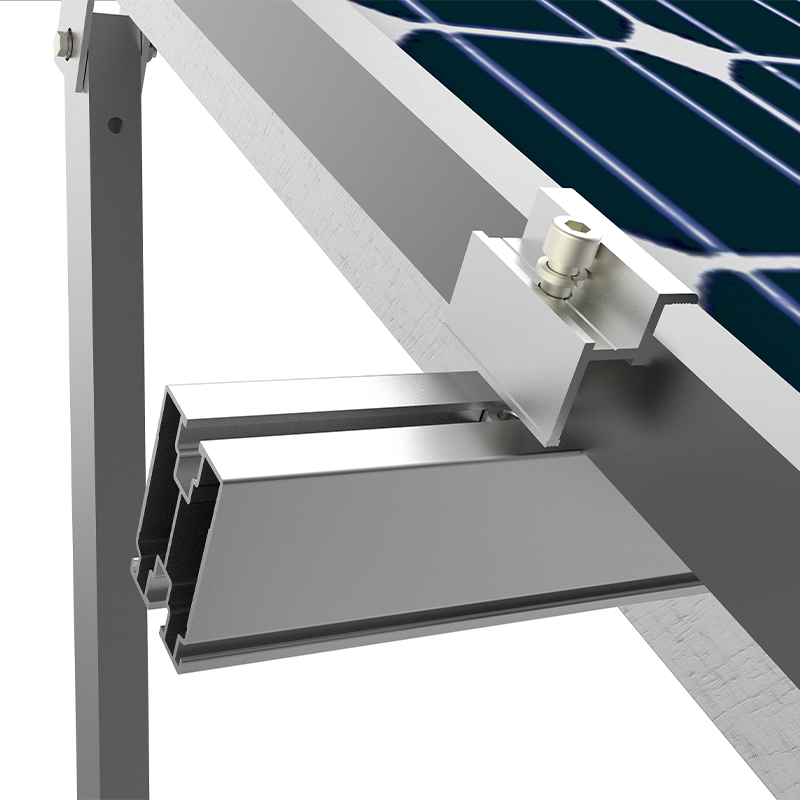 Wholesale Non-penetrating PV Mounting Factory, Manufacturers - Taizhou DongshengTaizhou Dongsheng New Energy Technology Co., Ltd is China wholesale Non-penetrating PV Mounting manufacturers and Non-penetrating PV Moun...View Product →
Material Selection: Aluminum Alloy vs. Carbon Steel
Aluminum and carbon steel are not competing products; they serve different project profiles. Aluminum is the better partner for roofs, coastal sites, and any location with high humidity, because of its natural corrosion resistance and low weight. Carbon steel is the heavy-duty workhorse for large ground-mounted plants, where strength per dollar and large spans matter more than shipping weight.
| Property | Aluminum Alloy | Carbon Steel |
|---|---|---|
| Weight | About one-third of steel, easier to handle and install | Heavy; requires more transport and lifting effort |
| Corrosion resistance | Naturally high, especially in coastal or humid environments | Requires hot-dip galvanizing or protective coating |
| Strength | Good for distributed roof loads | Higher yield strength for large spans and heavy loads |
| Surface treatment | Anodizing for extended service life | Hot-dip galvanizing is the industry standard |
| Best suited for | Roof systems, BIPV, humid and saline conditions | Ground plants, large-span structures, cost-sensitive projects |
| Relative cost | Higher material cost, lower logistics and installation cost | Lower material cost, competitive for large volumes |
Surface treatment is the detail that separates a durable bracket from a premature failure. In salt-heavy coastal air, anodized aluminum performs exceptionally well. In ground projects, hot-dip galvanized steel provides dependable protection at a fraction of the aluminum cost. Note that in modern BIPV systems, waterproof mounting structures are available in both carbon steel and aluminum, so the material decision should follow the structural and environmental requirements of the specific site.
Installation Efficiency and Maintenance Accessibility
Installation speed matters, but so does the ability to service a single module years later. In RV solar forums, owners frequently complain about simple L- or Z-shaped brackets: they are quick to attach the first time, but the screws end up buried under the panel. To clean, repair, or replace the module, the installer must remove the entire bracket assembly from the roof first.
Non-penetrating and modular designs solve this problem in two ways. First, clamp-based mounting allows a single module to be released independently without disturbing its neighbors. Second, ballasted and rail-based systems make it easy to adjust the position of a panel after installation. Pre-assembled components further shorten the construction schedule, which reduces labor cost on both small residential jobs and large commercial rooftops.
Solar Panel Mounting Bracket Solutions for Every Installation Scenario
The same selection logic applies from the rooftop to the ground: the environment defines the structure. Break the decision down by scenario, and the right product family becomes obvious.
Flat Roof and Pitched Roof Solutions
For flat roofs, there are two common layout strategies. The first is an adjustable-tilt frame that angles panels toward the sun and maximizes energy yield. The second is a horizontal or low-tilt layout that reduces wind uplift and allows a lighter ballast system. Non-penetrating ballasted frames are the preferred option for membrane roofs because they preserve the waterproofing layer completely. On concrete roofs where penetrations are acceptable, a penetrating system with proper flashing offers higher resistance to wind lift and is often specified in high-wind zones.
For pitched roofs, the bracket structure must match the slope and the covering material. Tile roofs use hooks under the tiles, while metal roofs use seam clamps. In both cases, the design should leave an airflow gap between the modules and the roof surface. This gap keeps the roof cooler and improves module efficiency, while also giving moisture a path to escape.
Ground-Mounted Systems for Large-Scale Projects
Ground systems face a different set of challenges: soil conditions, terrain slope, and much larger wind exposure. The foundation is usually the first decision. Driven piles and screw piles suit flat, stable ground, while concrete piers are preferred in soft or rocky soil. The entire structure must be engineered for the local wind zone, because a ground array has no building to shield it.
On mountainous terrain, slope and elevation differences are the main obstacles. Double-column mountain PV mounting structures provide excellent stability on steep slopes by spreading the load across two support points. For sites with significant height variation between rows, single-column sleeve structures allow installers to adjust the column height on site, which reduces the need for expensive grading work.
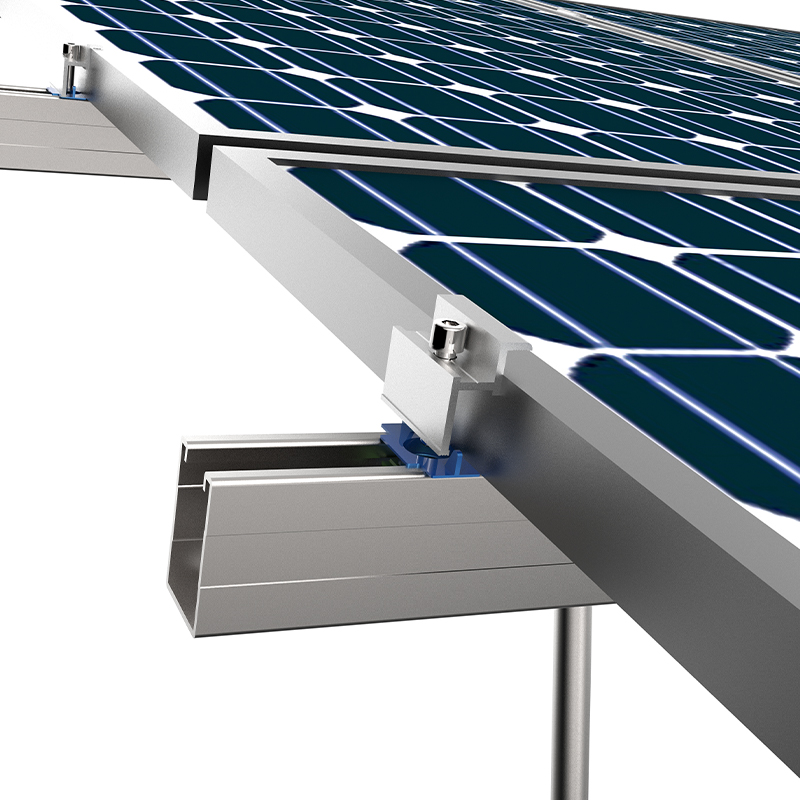 Wholesale Double Column PV Mounting Factory, Manufacturers - Taizhou Dongsheng NTaizhou Dongsheng New Energy Technology Co., Ltd is China wholesale Double Column PV Mounting manufacturers and Double Column PV Mounting...View Product →
In desert environments, the bracket must resist wind-driven sand and high temperature cycles. Reinforced fixed structures with tightly sealed fasteners are used to prevent sand from abrading the coating and loosening connections. Where land is flat but open, a steel ground-mount system remains the most economical choice because of its strength and low cost per watt.
Specialized Solutions: BIPV, Carports, Balconies, and Agri/Fishery PV
Some installations are defined by a secondary function rather than just energy production.
BIPV (Building-Integrated Photovoltaics) turns the mounting system into part of the building envelope. Waterproof BIPV frames replace conventional roofing material, so they must provide reliable drainage and sealing in addition to mechanical support. For commercial and industrial roofs where waterproofing is the top priority, carbon steel waterproof BIPV mounting systems combine structural rigidity with integrated water management.
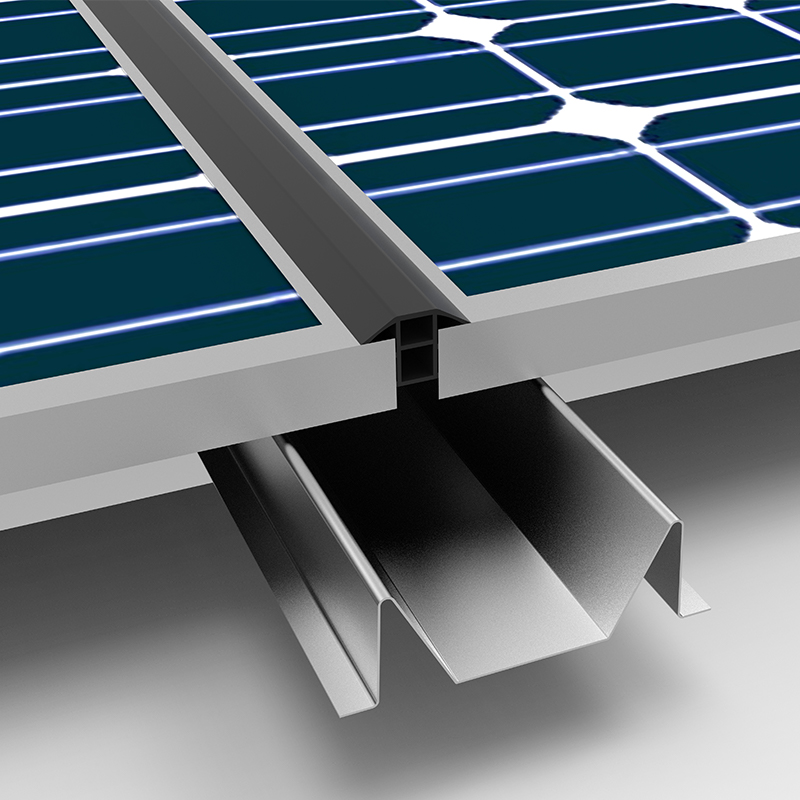 Wholesale M-type Carbon Steel Waterproof PV Mounting Factory, Manufacturers - TaTaizhou Dongsheng New Energy Technology Co., Ltd is China wholesale M-type Carbon Steel Waterproof PV Mounting manufacturers and M-type C...View Product →
Solar carports serve double duty as vehicle shade and power generation. The bracket structure must span large open areas while withstanding wind loads, which makes engineered steel frames the standard choice. Solar carport mounting systems are designed for both parking lot layouts and commercial canopy projects.
Balcony systems answer a different need: lightweight, compact, and installable with hand tools. They are popular for urban apartment dwellers and are increasingly relevant for anyone looking for a simple, removable solar setup. Balcony PV mounting systems prioritize easy installation and low structural impact.
Fishery-solar hybrid projects mount panels above fish ponds, where humidity and water vapor are constant. Corrosion protection becomes the dominant requirement. Fishery-solar hybrid PV mounting solutions use corrosion-resistant materials and sealed joints to survive in this demanding environment. Agri-solar systems, by contrast, must maintain enough height above the ground to let farming equipment pass underneath, which drives the structure to taller columns and wider spans.
Emerging Trends in Solar Bracket Technology
Solar bracket technology is moving beyond static rails and simple clamps. Three developments are worth tracking for any serious project planner.
Tracking systems are the most direct way to improve energy yield. Single-axis and dual-axis trackers rotate the modules to follow the sun through the day, increasing annual production compared with a fixed tilt. Manual and automatic versions are available, and the choice depends on whether the project owner wants lower upfront cost or maximum output.
Flexible mounting systems use struts or cable-supported structures to span large distances with few foundations. This makes them attractive for terrain where driving piles is difficult or expensive, such as uneven mountain slopes, ponds, and sites with rocky subsoil. Their lighter footprint also reduces site disturbance.
Modular pre-assembled designs are reshaping installation logistics. Factory assembly shortens on-site installation time and lowers the risk of construction errors. Combined with standardized connectors, these systems make later module replacement and system expansion noticeably simpler.
Finally, the growth of BIPV confirms that mounting structures are becoming an integrated part of building design rather than an add-on accessory. Waterproof and aesthetically integrated systems will continue to gain share in commercial and industrial construction.
How to Choose a Reliable Solar Mounting Bracket Manufacturer
The bracket is a small share of the total system cost, but a failure costs far more than the bracket itself. That is why supplier selection deserves the same discipline as product selection.
Three criteria separate a dependable manufacturer from a marginal one:
- Product line breadth: a supplier that covers flat roofs, tile roofs, metal roofs, TPO roofs, ground systems, BIPV, carports, balconies, and agri/fishery applications can recommend the right structure instead of pushing whatever it happens to sell. One-stop procurement also reduces coordination risk across multiple vendors.
- Certifications and quality systems: ISO-certified manufacturing processes are the baseline for consistent product quality. A manufacturer operating under formal quality management is more likely to deliver uniform tolerances and reliable coatings.
- Proven delivery scale: large project references show that a manufacturer can handle volume and logistics. For example, a company that has supplied more than 1.5 GW of distributed mounting systems in a single year, or delivered a 200 MWp-class fishery-solar hybrid project, has demonstrated the production capacity and project management that smaller suppliers may lack.
Long-term service is just as important. The best manufacturer acts as a partner, offering structural calculations, installation guidance, and after-sales support for the full life of the project. A manufacturer established since 2009, with a track record of introducing new products such as waterproof BIPV brackets, flexible mounting structures, and tracking systems, is far better positioned to support your project than one selling a single generic profile.
Conclusion: Let the Project Define the Bracket
The selection logic of this guide can be summarized in one sentence: the scenario determines the structure, and the structure determines the material. Start by mapping the real conditions of the site, including roof type, local wind and snow loads, maintenance access, and the building or land use underneath.
Then follow the four steps in order. First, identify the installation scenario and its structural requirements. Second, select the bracket structure family that matches the roof or ground condition. Third, choose the material, aluminum or carbon steel, based on corrosion exposure and cost. Finally, verify that the chosen system is easy to install and service over the long term.
Once the bracket type is clear, apply the same rigor to the supplier. Look for a manufacturer with a complete product range, recognized certifications, demonstrated delivery capacity, and real project references. Send your roof drawings or site conditions to a qualified mounting system supplier and let the data guide the final configuration. A good manufacturer will help you turn these selection factors into a site-specific solution that protects both the roof and the return on your solar investment.
Message Us Now !

 +86-0523-80509588

 11th Floor, Wenchuang Building, 60 Fenghuang East Road, Hailing District, Taizhou City, JiangSu, China
Mounting Systems
Copyright © Taizhou Suneast New Energy Technology Co., Ltd.
All Rights Reserved.
 OEM/ODM Solar Panel Mounting Bracket Manufacturers