English
 日本語
 Deutsch
 عربى
 中文


Solar OEM: The Complete Guide to Custom PV Modules and Mounting Systems
 2026.10.29
 Industry News
Suppose you are planning a 500 kW commercial roof installation and the building has an unusual parapet structure. Standard ballasted racks would require too much cutting, and imported components are expensive. Or perhaps you want to launch a residential solar brand with a distinctive all-black panel design. In both cases, solar OEM is the route that lets you adapt components to your exact needs. The idea is straightforward, but successful execution depends on understanding the product categories, the supplier landscape, and the risks hidden in the fine print.
What Does Solar OEM Actually Mean?
Original equipment manufacturing in the solar industry means a factory produces a component under your brand, following your technical specifications. The supplier purchases the raw material, designs the production process, and delivers a finished part that you can sell or integrate into your own system. In the PV sector, OEM is most common for solar modules, mounting systems, and in some cases inverters.
A common confusion is the difference between OEM and ODM. In a pure OEM arrangement, the customer provides the design or detailed specification. In an ODM scenario, the manufacturer takes the lead on design and only adds your branding. Many solar racking suppliers act as ODM for standard profiles but call the whole service OEM. Clarify this distinction early so that your expectations about engineering ownership are aligned.
Why Solar OEM Matters for Project Buyers
OEM is not just for large utility developers. Small and mid-sized installers use it to create repeatable project templates, to satisfy aesthetic demands, or to secure stable pricing on key components. The main advantages are:
- Customization: You can fine-tune module dimensions, colors, or racking geometry to a specific roof or ground condition.
- Cost optimization: Instead of buying a standard product designed for a broad audience, you pay for the material and engineering that your project actually needs.
- Brand building: Products carrying your own brand strengthen future marketing and product recognition.
- Supply chain control: Working directly with a factory shortens communication and gives you more influence on quality and delivery.
At the same time, the buyer inherits responsibility for specification accuracy. A missing wind-load calculation or an uncoated clamp in a coastal area can lead to failures years after commissioning.
The Two Sides of Solar OEM: Modules and Mounting Systems
When people search for "solar OEM," they usually mean panels. But mounting systems represent a critical part of the balance of system (BOS). A panel with excellent efficiency is useless if the racking collapses under the first strong gust. Let’s look at both sides.
Custom Module Considerations
Module OEM is heavily standardized. Most factories run production lines for half-cut mono PERC or TOPCon cells. You can choose the power class, the number of busbars, the frame color, and the label design. Certification is a major checkpoint: IEC 61215 for performance and IEC 61730 for safety are almost mandatory for export to Europe and North America. Also consider the minimum order quantity (MOQ). Some lines accept 100-piece orders for customized labels, while special back-contact cells usually require a full container. Confirm the MOQ before investing time in a specification.
Custom Mounting System Considerations
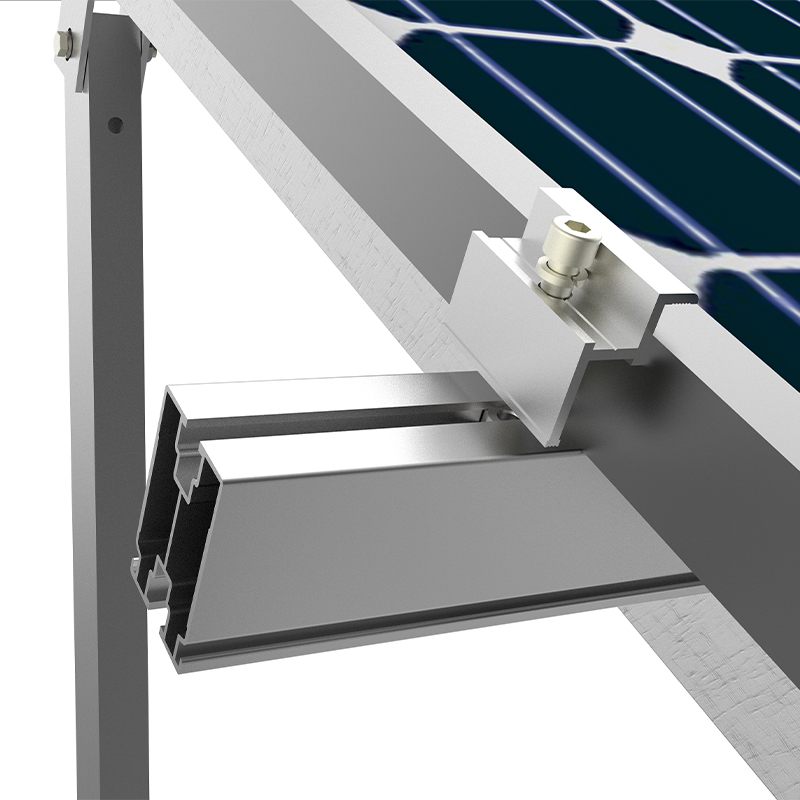
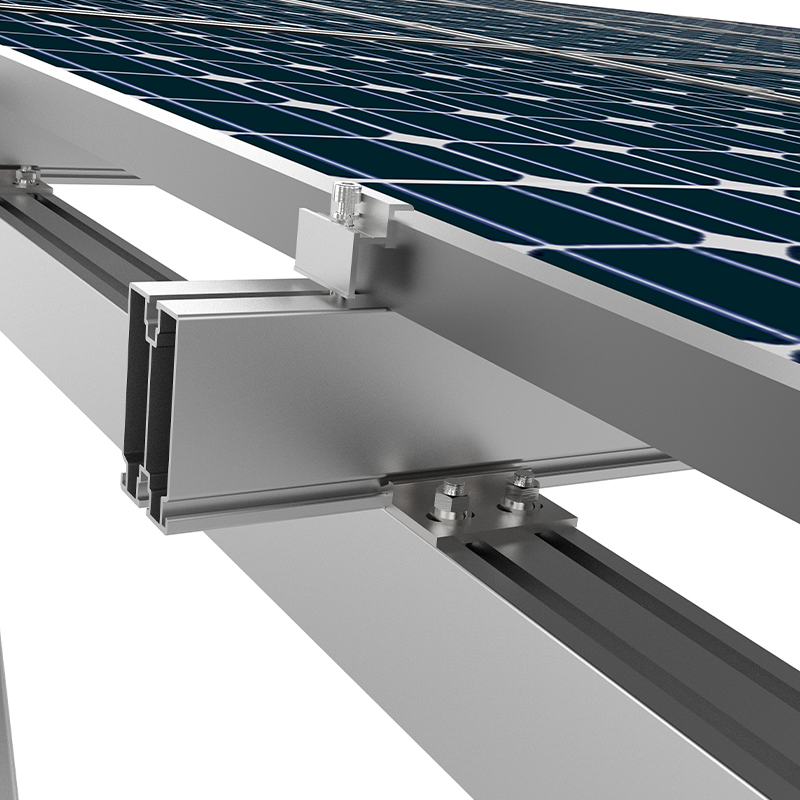
Mounting systems are less modular than panels, but OEM provides great flexibility in geometry, coating, and accessories. A manufacturer with in-house engineering can adjust rail profiles, clamp widths, and base plate thickness without starting from zero. The three most common customization scenarios we see are:
Flat roof mounts. Commercial flat roofs often need non-penetrating ballasted systems. The OEM can modify the tray width, ballast trough shape, and wind deflector angle. For projects where roof penetration is allowed, a penetrating rail system with customized flashing can also be produced.
 Non-penetrating Ballasted PV Mounting for Flat Concrete RoofsThis system uses concrete counterweights to avoid roof penetration, protecting waterproofing while allowing tilt adjustments. Ideal for commercial flat roofs where non-invasive installation is required.View Product →
Fishery-solar hybrid mounts. Installing panels above fishponds or brackish water demands corrosion-resistant materials and a structure that can handle wave motion or frequent humidity. The supplier should be able to offer hot-dip galvanized steel or marine-grade aluminum, plus specific bolts mounted with vibration-proof washers.
 Fishery-solar Hybrid PV Mounting System for Water SurfacesDesigned for aquaculture ponds, this high bracket system supports panels above water with corrosion-resistant materials and deep pile foundations, enabling dual use of water space.View Product →
Carport structures. A solar carport is a parking shade and a power generator. It needs larger beams, diagonal braces, and careful integration with rainwater drainage. Custom colors are often requested to match building facades or local design guidelines.
 Carport PV Mounting Structure with Customizable ConfigurationsThis solar carport integrates power generation with parking shade, featuring high-strength steel or aluminum, adjustable roof designs, and options for charging piles or storage systems.View Product →
The complexity of racking customization varies with the roof type. The following chart is based on our project experience. It rates the relative effort needed to adapt a racking design for different roof finishes.
Flat roof
Metal pitched roof
Clay tile roof
In the chart, flat roofs score lower because rails and ballast can be laid out freely. Clay tile roofs are more demanding because the hooks must match the tile profile and often require special spacer pieces. Always ask the OEM partner for load calculations and 3D models when dealing with high complexity ratings.
When comparing quotes, do not focus only on price per watt or per kilogram. A complete mounting system OEM offer should include structural calculations, installation drawings, and site guidance. For a deeper discussion of the technical steps, see our complete guide to designing and installing roof PV mounting systems.
How to Qualify a Solar OEM Partner
The right partner must be a manufacturer, not just a trading company. Use the following criteria to filter candidates:
- Design capability. Request examples of finite element analysis (FEA) reports. If a supplier cannot simulate wind and snow loads, they are not an OEM partner.
- Quality management. Look for ISO 9001 certification and an internal QC system. Ask about incoming material inspection, weld testing, and coating thickness measurement.
- Material honesty. A reliable partner will declare the exact steel grade (for example Q235 or S250GD) and the zinc coating mass per square meter. These values affect service life in outdoor conditions.
- Project portfolio. Ask for references in your market segment. A company that has built fishery-solar mounts in coastal regions will be more useful than a purely rooftop supplier.
- Logistical reach. Check whether they export to your country and can provide the required packaging and customs documentation.
Pricing is another aspect. Low-cost quotes often exclude engineering services, packaging, and test reports. Ask for a breakdown that separates material, labor, and design costs. This transparency helps you compare offers fairly.
For ground-mounted utility projects, reviewing a typical ground mounting system product range can provide a baseline for what the supplier already produces. If your planned layout is far from their standard, discuss how many adjustments are needed.
The OEM Order Process: From Specification to Delivery
Once you select a supplier, the project usually moves through these stages:
- Define requirements. Provide site drawings, local wind/snow data, and module dimensions. Clarify if you need custom branding or packaging.
- Request a preliminary design. The supplier returns a bill of materials (BOM), rail size, clamp type, and estimated weight. Check if the proposed material meets your corrosion expectations.
- Approve samples. Always request a small sample kit. Install it in a real or simulated location to verify fit and ease of assembly.
- Sign production contract. Include delivery terms, quality criteria, and penalty clauses for delays.
- Inspect during production. Appoint a representative to check welding quality, coating uniformity, and dimensional tolerances before packing.
- Final acceptance and shipment. Verify packing lists and material certificates. Photograph or video the pallets before they leave the factory.
Lead times depend on the complexity. Standard customized racks can be shipped within 2 to 4 weeks, while a completely new structure may require 6 to 8 weeks including design validation. For large volumes, confirm that the factory can handle your order without diluting quality control.
Solar OEM is a practical way to get products that fit your market. Modules receive most of the attention, but mounting systems carry real risk. Make sure your supplier is a genuine manufacturer, willing to share engineering data, and able to provide installation support until your crews are confident. When these conditions are met, OEM becomes a durable competitive advantage rather than a procurement gamble.
Message Us Now !

 +86-0523-80509588

 11th Floor, Wenchuang Building, 60 Fenghuang East Road, Hailing District, Taizhou City, JiangSu, China
Mounting Systems
Copyright © Taizhou Suneast New Energy Technology Co., Ltd.
All Rights Reserved.
 OEM/ODM Solar Panel Mounting Bracket Manufacturers