English
 日本語
日本語 Deutsch
 عربى
عربى 中文
中文

Does the ground-mounted PV system have anti-tilting and anti-settlement designs?
 2025.12.18
 Industry News
Basic Structural Characteristics of Ground-Mounted PV Systems
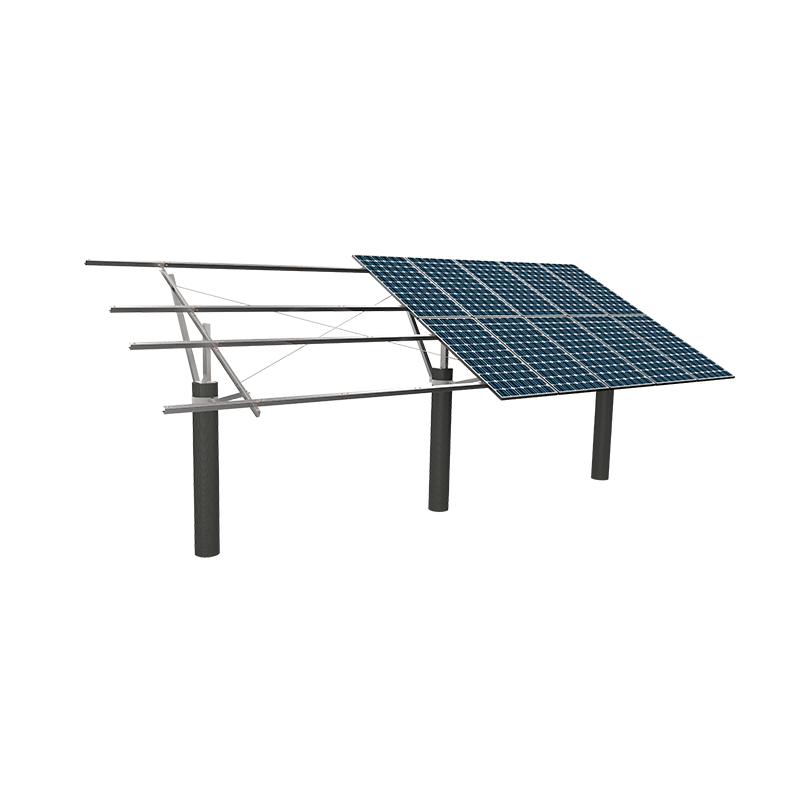
A ground-mounted PV system is installed directly on natural soil, compacted fill, or prepared foundations, rather than on rooftops or building structures. Because the system relies on contact with the ground for support, its structural design must account for soil behavior, environmental loads, and long-term stability. Anti-tilting and anti-settlement considerations are therefore closely linked to the way foundations, supports, and connections are engineered.
Understanding Tilting and Settlement Risks
Tilting refers to the gradual or sudden inclination of the PV structure away from its designed angle, while settlement describes the downward movement of foundations due to soil compression or displacement. Both phenomena can occur independently or together. In ground-mounted PV systems, these risks are influenced by soil type, groundwater conditions, load distribution, and external forces such as wind or snow.
Role of Foundation Design in Anti-Tilting Performance
The foundation is the primary element responsible for resisting overturning and lateral movement. Ground-mounted PV systems commonly use pile foundations, ground screws, concrete footings, or ballast blocks. Each foundation type provides a different mechanism for resisting tilt by transferring loads into deeper or more stable soil layers. Proper foundation selection is a core aspect of anti-tilting design.
Common Foundation Types and Anti-Tilting Functions
| Foundation Type | Main Load Transfer Method | Anti-Tilting Contribution |
|---|---|---|
| Driven piles | Skin friction and end bearing | Resist overturning through depth |
| Ground screws | Helical anchoring | Provide rotational resistance |
| Concrete footings | Weight and base area | Stabilize through mass and spread |
| Ballasted systems | Gravity load | Limit movement without penetration |
Soil Investigation and Its Impact on Stability
Anti-tilting and anti-settlement designs begin with soil investigation. Geotechnical surveys identify soil bearing capacity, compaction level, moisture content, and layering. These parameters guide decisions on foundation depth, spacing, and type. Without adequate soil data, even well-designed structures may experience uneven settlement or inclination over time.
Load Distribution Across the PV Array
Ground-mounted PV systems distribute loads from modules, frames, and environmental forces across multiple supports. Uniform load distribution helps reduce localized stress on individual foundations. Structural layouts often use evenly spaced rows and supports to ensure that loads are shared, which reduces the likelihood of differential settlement that could lead to tilting.
Wind Load Considerations and Anti-Tilting Measures
Wind is a major contributor to tilting risk, especially in open-field installations. PV modules act as large flat surfaces that can generate uplift and lateral forces. Anti-tilting designs account for wind direction, speed, and turbulence by reinforcing foundations, increasing embedment depth, or adjusting tilt angles to reduce aerodynamic effects.
Structural Bracing and Frame Geometry
Bracing elements within the mounting structure contribute to overall rigidity. Diagonal braces, cross members, and reinforced joints help maintain alignment under load. A well-designed frame geometry limits deformation and distributes forces more evenly, reducing the likelihood that one support will rotate or sink more than others.
Anti-Settlement Design Through Foundation Depth
Settlement often results from soil compression under sustained load. By extending foundations into deeper, more stable soil layers, designers reduce reliance on surface soil that may be prone to compaction. Deeper foundations can transfer loads to strata with higher bearing capacity, limiting long-term vertical movement.
Factors Influencing Settlement in Ground-Mounted PV Systems
| Factor | Influence on Settlement | Design Response |
|---|---|---|
| Soil type | Compressibility varies | Adjust foundation depth |
| Moisture changes | Soil expansion or shrinkage | Drainage and soil treatment |
| Load magnitude | Higher stress on soil | Increase support area |
Drainage Design and Moisture Control
Water accumulation around foundations can weaken soil and accelerate settlement. Ground-mounted PV systems often include drainage measures such as gravel layers, slopes, or channels to divert water away from supports. Effective moisture control helps maintain soil strength and reduces uneven ground movement.
Use of Adjustable Mounting Components
Some ground-mounted PV systems incorporate adjustable mounting brackets or telescopic supports. These features allow minor corrections to alignment if small settlements occur. While they do not replace proper foundation design, adjustability provides a practical way to maintain module orientation during the system’s service life.
Compaction and Ground Preparation Practices
Before installation, ground preparation plays a key role in anti-settlement performance. Compaction of fill material, removal of organic layers, and leveling of the site help create a uniform base. Proper preparation reduces variability in soil behavior beneath different supports.
Material Selection and Long-Term Structural Behavior
The materials used in foundations and mounting structures influence long-term stability. Steel piles, aluminum frames, and concrete footings each respond differently to environmental conditions. Corrosion resistance and material stiffness affect how loads are sustained over time, indirectly influencing tilting and settlement behavior.
Monitoring and Maintenance for Early Detection
Even with careful design, ground conditions can change. Periodic inspection of alignment, foundation exposure, and ground condition helps identify early signs of tilting or settlement. Monitoring allows corrective actions such as re-compaction or structural adjustment before larger deviations develop.
Influence of Seismic and Thermal Effects
In some regions, seismic activity and temperature variation also affect stability. Seismic loads can induce temporary or permanent ground movement, while thermal expansion and contraction can stress connections. Anti-tilting designs account for these effects by allowing controlled movement without loss of structural integrity.
Integration of Engineering Standards and Local Codes
Ground-mounted PV systems are typically designed according to engineering standards and local building codes. These frameworks define safety factors, load combinations, and testing requirements related to stability. Compliance with such standards supports systematic consideration of anti-tilting and anti-settlement requirements.
Design Elements Addressing Stability Concerns
| Design Element | Target Issue | Stability Contribution |
|---|---|---|
| Foundation depth | Settlement | Transfers load to stable layers |
| Bracing system | Tilting | Improves frame rigidity |
| Drainage layout | Soil weakening | Maintains soil strength |
Adaptation to Different Terrain Conditions
Ground-mounted PV systems are installed on flat land, slopes, and uneven terrain. Each condition presents unique stability challenges. Sloped sites may require stepped foundations or terracing, while soft soils may need reinforcement. Anti-tilting and anti-settlement designs are adapted accordingly to suit site-specific conditions.
Long-Term Structural Reliability Considerations
Over the service life of a ground-mounted PV system, gradual changes in soil and load conditions are expected. Designs that account for long-term behavior, rather than only initial installation conditions, are better suited to maintaining alignment. This perspective integrates geotechnical, structural, and environmental considerations into a unified approach.
Message Us Now !

 +86-0523-80509588

 11th Floor, Wenchuang Building, 60 Fenghuang East Road, Hailing District, Taizhou City, JiangSu, China
Mounting Systems
Copyright © Taizhou Suneast New Energy Technology Co., Ltd.
All Rights Reserved.
 OEM/ODM Solar Panel Mounting Bracket Manufacturers