English
 日本語
日本語 Deutsch
 عربى
عربى 中文
中文

Does the ground PV mounting system support large-span structural designs?
 2026.02.26
 Industry News
Understanding Large-Span Structural Design in Ground PV Mounting Systems
The question of whether a ground PV mounting system can support large-span structural designs is closely linked to modern trends in utility-scale solar development. Large-span structures typically refer to mounting configurations where the distance between support columns or foundations is extended beyond conventional spacing. This approach is often considered to reduce the number of foundations, simplify site preparation, and improve land utilization. In ground-mounted photovoltaic installations, structural span affects mechanical stability, material selection, installation strategy, and long-term operational reliability.
Ground PV mounting systems are engineered frameworks designed to support photovoltaic modules under varying environmental conditions. Their ability to accommodate large spans depends on structural calculations, load distribution analysis, soil conditions, and material properties. Rather than being a universal yes-or-no answer, large-span feasibility depends on engineering adaptation and project-specific design considerations.
Structural Mechanics and Load Distribution Considerations
Large-span designs introduce higher bending moments and deflection forces within beams and purlins. As the distance between support points increases, structural members must resist greater mechanical stress caused by wind loads, snow loads, and the self-weight of modules. Engineers calculate load combinations using regional environmental data to ensure that deflection remains within acceptable serviceability limits.
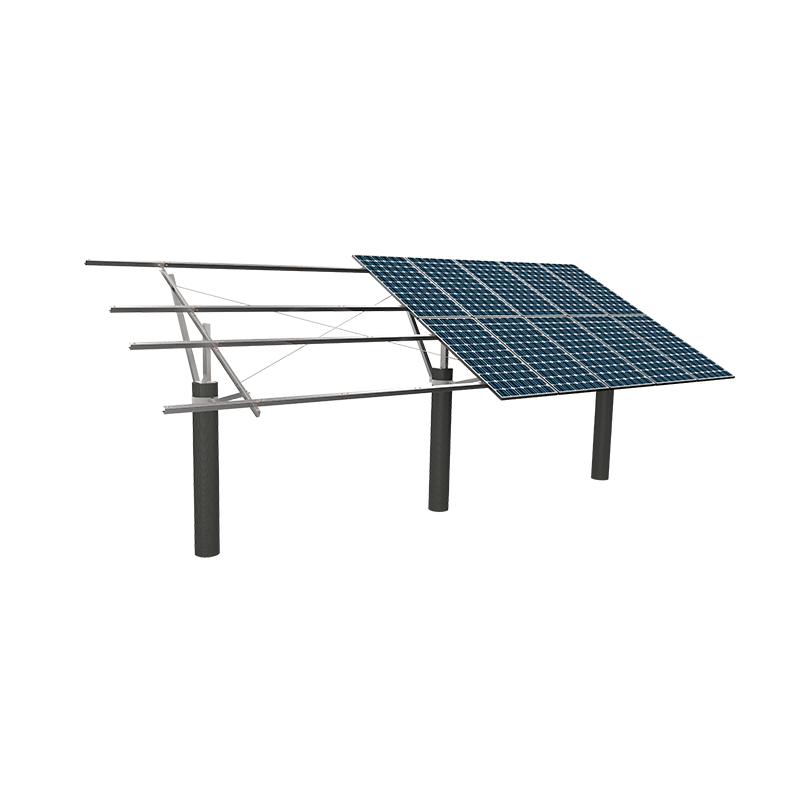
In a ground PV mounting system, load transfer typically flows from modules to rails, from rails to main beams, and then to foundations. When span length increases, cross-sectional dimensions of beams may need adjustment to prevent excessive deformation. Advanced structural modeling software allows designers to simulate stress distribution across extended spans, helping determine whether reinforcement or material upgrades are required.
Material Selection and Its Influence on Span Capability
The capacity of a mounting structure to support larger spans is influenced by the mechanical characteristics of its materials. Galvanized steel and aluminum alloys are commonly used in ground-mounted solar systems. Steel generally offers higher tensile strength and stiffness, making it suitable for longer spans when properly treated against corrosion. Aluminum provides reduced weight and ease of handling, but its modulus of elasticity is lower, which may require thicker sections in long-span applications.
Material thickness, yield strength, and connection integrity all contribute to span performance. In some cases, hybrid designs combining steel columns with aluminum rails are used to balance structural strength and installation efficiency. Corrosion resistance also becomes important, especially in coastal or high-humidity environments, as material degradation over time may affect long-span structural behavior.
Foundation Design and Soil Interaction
Large-span structural systems place concentrated loads on fewer foundation points. This increases the importance of geotechnical analysis before construction. Soil bearing capacity, settlement characteristics, and groundwater levels influence the type of foundation selected. Driven piles, helical piles, and concrete footings each respond differently to vertical and lateral forces.
When spans increase, foundation embedment depth and diameter may need adjustment to maintain overall system stability. Lateral loads generated by wind uplift are particularly relevant for ground PV mounting systems with extended spans. Proper anchoring and soil compaction help prevent rotation or displacement. Therefore, the support of large-span designs depends not only on superstructure strength but also on substructure performance.
Wind Load Resistance and Aerodynamic Effects
Wind loading is often the governing factor in determining maximum span length. As spans grow longer, structural members experience amplified bending due to wind pressure and uplift. Aerodynamic studies evaluate how air flows beneath and over module surfaces, especially in open-field solar plants where exposure is high. Panel tilt angle and array orientation influence wind distribution patterns.
The following table illustrates how span length may influence structural requirements under wind load conditions:
| Span Length | Beam Section Requirement | Foundation Reinforcement | Wind Sensitivity |
| Short Span | Standard Profile | Conventional Depth | Moderate |
| Medium Span | Reinforced Section | Increased Embedment | Elevated |
| Large Span | Heavy-Duty Profile | Enhanced Anchoring | High |
Wind tunnel testing and computational fluid dynamics modeling assist engineers in evaluating aerodynamic performance before field deployment. These assessments determine whether the ground PV mounting system can maintain structural integrity with expanded support spacing.
Thermal Expansion and Structural Flexibility
Temperature variations affect structural components, especially in large outdoor installations. Metal materials expand and contract with temperature fluctuations, and longer spans amplify cumulative thermal movement. Without proper expansion joints or sliding connections, stress concentrations may develop at connection points.
Designers incorporate slotted holes or flexible brackets to accommodate thermal displacement while maintaining alignment. This is particularly important in regions with significant seasonal temperature variation. Ensuring controlled flexibility allows large-span mounting systems to maintain mechanical stability without imposing excessive constraint forces.
Installation Efficiency and Construction Implications
One reason developers consider large-span designs is the potential reduction in the number of support columns. Fewer foundations may translate into shorter installation timelines and lower excavation requirements. However, longer beams can be heavier and more challenging to transport or position on site. Crane capacity and worker safety must be evaluated accordingly.
Prefabricated modular components may help streamline installation. Some ground PV mounting system manufacturers design pre-assembled beam sections that are bolted together in the field. This approach reduces on-site welding and ensures consistent structural alignment. Nevertheless, careful planning is required to prevent logistical challenges associated with transporting longer structural elements.
Economic Trade-Offs in Large-Span Designs
Large-span configurations can reduce the total number of foundations, but they may require thicker steel profiles or reinforced connections. The overall cost balance depends on material pricing, labor costs, and site conditions. In some cases, the reduction in civil work offsets the additional expense of heavier structural members. In other scenarios, especially where soil conditions demand deeper foundations, savings may be limited.
Developers often perform cost-benefit analysis comparing conventional spacing with extended spans. Factors considered include material consumption per megawatt, installation time, and long-term maintenance requirements. A ground PV mounting system designed for adaptability allows project planners to optimize span length according to site-specific economic conditions.
Compliance with Engineering Standards and Codes
Any decision to adopt large-span structural designs must comply with regional building codes and structural engineering standards. These regulations define permissible deflection limits, load combinations, and safety factors. For utility-scale photovoltaic projects, adherence to national structural codes ensures that mounting systems withstand environmental stress over their intended service life.
Structural certification processes typically involve third-party review of design calculations and sometimes physical load testing. A ground PV mounting system that supports large spans must demonstrate compliance with wind, snow, and seismic requirements applicable to the installation site. Certification enhances project reliability and supports insurance and financing processes.
Long-Term Maintenance and Operational Stability
Over time, structural components are exposed to mechanical fatigue, corrosion, and environmental wear. Large-span systems may experience different stress distribution patterns compared to closely spaced supports. Regular inspection of connection bolts, beam deflection, and foundation alignment is essential to maintain operational stability.
Monitoring systems can detect gradual misalignment or excessive movement. Preventive maintenance programs help ensure that structural performance remains within design expectations. When properly engineered and maintained, large-span ground PV mounting systems can sustain stable support for photovoltaic modules across extended service periods.
Adaptability to Terrain and Site Constraints
Project sites often feature uneven terrain, slopes, or obstacles that influence structural layout. Large-span designs may provide flexibility by bridging minor surface irregularities without requiring extensive grading. However, in areas with steep slopes or highly variable soil conditions, shorter spans may offer better adaptability and structural predictability.
Customizable mounting frameworks allow engineers to adjust column height and beam alignment according to topographic conditions. The feasibility of large-span implementation therefore depends on both engineering capacity and the physical characteristics of the project site.
Technological Innovation and Future Developments
Advances in structural modeling software, high-strength materials, and modular construction techniques continue to expand the possibilities for large-span ground PV mounting systems. Finite element analysis enables detailed stress simulation under combined load scenarios. Improved galvanization processes enhance corrosion resistance, extending the service life of steel components in challenging environments.
As photovoltaic module dimensions evolve and bifacial panels gain wider adoption, mounting system configurations may adapt to optimize light exposure and airflow. These technological developments contribute to more flexible structural design options, including configurations that accommodate extended spans without compromising mechanical stability.
Message Us Now !

 +86-0523-80509588

 11th Floor, Wenchuang Building, 60 Fenghuang East Road, Hailing District, Taizhou City, JiangSu, China
Mounting Systems
Copyright © Taizhou Suneast New Energy Technology Co., Ltd.
All Rights Reserved.
 OEM/ODM Solar Panel Mounting Bracket Manufacturers